

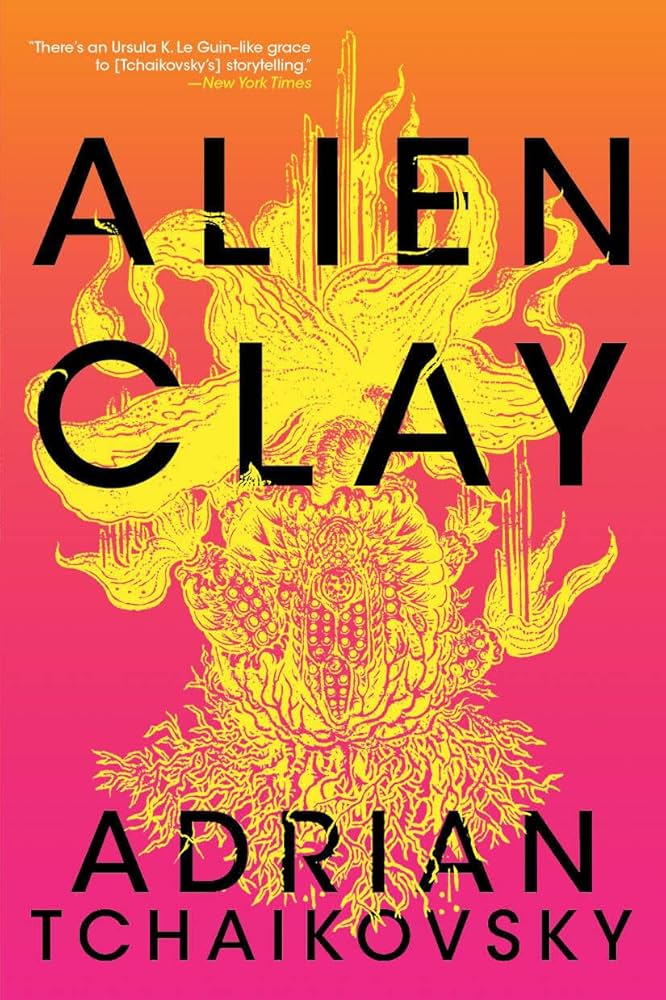
I’ve a soft spot for science fiction that threads the needle between big ideas and human frailty, and Adrian Tchaikovsky’s Alien Clay (2024) scratches exactly that itch. Published on 06 June 2024, it’s a story of alien contact and the thorny, all-too-human challenges of cultural understanding and survival. What follows are my thoughts as a sci‑fi and dystopia devotee who reads with equal parts curiosity and caution.
Alien Clay by Adrian Tchaikovsky: Contact and Survival
Tchaikovsky sets his tale on a harsh, vividly realised world where humans have been pushed to the margins—politically and physically. The set‑up is cleverly pragmatic: a fragile human foothold, a resource‑strapped colony, and a regime whose ideological rigidity has shipped inconvenient minds to the frontier. It’s a world where every breath is accounted for, every choice traded against tomorrow’s losses, and where the landscape itself feels palpably alien.
The contact in Alien Clay isn’t the clean handshake between species some space operas promise. It’s partial, messy, and risky—steeped in misunderstanding and the limits of perception. Tchaikovsky leans into biology and environment as language, implying that communication here isn’t just about words but reciprocal adaptation. When your habitat can kill you and your neighbours don’t think like you, every attempt at understanding is also an act of exposure.
Survival frames everything: food chains, social cohesion, and the politics of scarcity. The book turns survival into an ethical crucible—what are we willing to risk when the alternative is extinction by slow attrition? I loved how the narrative refuses easy solutions; each choice has ecological and cultural consequences that ripple outward. In that tension, Tchaikovsky finds a gripping, granular drama that feels earned rather than engineered.
Reviewing Alien Clay: Adrian Tchaikovsky on Culture and Risk
Tchaikovsky has long been fascinated by non‑human intelligences, and here he doubles down on culture as a living system. He probes how assumptions ossify into dogma and how contact can either erode or entrench those dogmas. The novel repeatedly asks: do we approach the Other as a puzzle to be solved, a threat to be neutralised, or a partner to be understood? It is strongest when it dramatises those choices at the personal level, showing the costs of curiosity and the price of caution.
Stylistically, the prose is clear‑eyed and unshowy, with a biologist’s attention to process and consequence. Pacing is measured rather than breathless; it rewards readers who enjoy world‑building that unfolds through systems—ecology, engineering, governance—rather than exposition dumps. If there’s a mild quibble, it’s that a few secondary characters feel more like vectors for ideas than fully rounded people, but the central through‑line more than compensates, and the atmosphere is top‑tier Tchaikovsky.
Culture, here, is risk management: rituals for living with uncertainty, stories that help a community decide what dangers to embrace. The novel situates contact at the intersection of necessity and ethics—our need to survive against our need to remain recognisably ourselves. Favourite line (paraphrase): real contact begins when survival stops being a zero‑sum game. It’s an idea that lingers after the final page, asking whether adaptation is capitulation or the highest expression of intelligence.
Alien Clay is a thoughtful, sinewy slice of first‑contact fiction that balances biological imagination with political bite. Released on 06 June 2024, it distils alien contact down to the daily calculus of who we feed, who we trust, and what truths we dare to test when the air itself feels thin. For readers who loved the ecological ambition of Children of Time and the cultural rigour of Le Guin, this is a confident, satisfying recommendation. Rating: 🍵🍵🍵🍵 (4/5)