

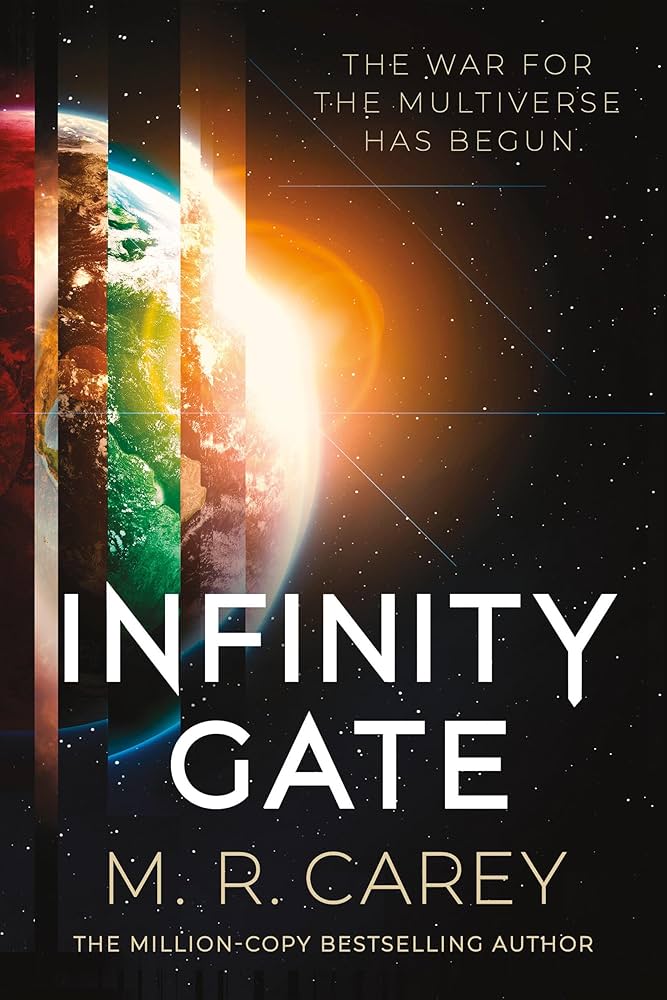
As a long-time lover of science fiction and dystopian tales, I’m always on the lookout for books that play with scale—big ideas, big worlds, big consequences. M. R. Carey’s 2023 novel Infinity Gate landed exactly in that sweet spot for me: a sweeping multiverse saga released on 28 March 2023, bristling with parallel Earths and the butterfly-effect chaos that follows from stepping between them. It’s a heady ride that asks, again and again, what we’re willing to pay for survival, knowledge, and power.
Infinity Gate by M. R. Carey: time travel, multiverses
Infinity Gate introduces a vast constellation of parallel worlds bound together by a sprawling polity often called the Pandominion—an audacious idea that Carey renders with a storyteller’s patience and a futurist’s imagination. Rather than the flash of literal time machines, the book leans into the vertigo of cause and effect across countless branches of reality. The result feels like time travel by another name: choices echoing sideways instead of forwards or backwards, with all the paradoxical unease left intact.
Carey’s worldbuilding is meticulous and wonderfully strange. Each Earth has its own evolution of culture, technology, ecology and threat, and he sketches them with deft strokes that suggest much more than we actually see. The politics of inter-world contact—trade, assimilation, resistance—give the story its spine, and there’s a real sense of the bureaucratic and military machinery grinding away beneath the spectacle.
Characters, too, are given room to breathe, and their moral dilemmas are where the book’s heart beats loudest. Identity, personhood and responsibility collide when lives and laws don’t match neatly across worlds. While Infinity Gate isn’t “time travel” in the traditional sense, it captures the genre’s best temporal anxieties: the dread that one choice today can fracture a thousand tomorrows you’ll never see, and the knowledge that some costs are both unavoidable and incalculable.
Favourite quote and verdict: 🍵🍵🍵🍵 unpredictable costs
My favourite line is one I’m paraphrasing from memory rather than quoting verbatim: that opening doors between worlds also opens debts you don’t get to settle alone. It’s the book’s central thesis in miniature—expansion as moral arithmetic, with interest charged across realities. The sentiment lingers long after the last page, precisely because it refuses an easy tally.
Verdict: four teacups out of five—🍵🍵🍵🍵. Infinity Gate is propulsive, imaginative and surprisingly tender, even when it turns sharp and political. A few infodumps and early-stage table-setting slow the pace in places, but the pay-off is strong, the stakes feel earned, and the unpredictability of the consequences gives the final act real bite.
If multiverses, near-future science and ethical conundrums are your brew, this is a generous, aromatic cup. Carey’s prose is clear without being plain, and the set-up promises even bolder moves as the cycle continues. Come for the parallel worlds; stay for the way the book makes those worlds feel dangerously, uncomfortably close to our own.
Infinity Gate (28 March 2023) is M. R. Carey operating at an ambitious scale: a multiverse tale about power, responsibility and the debts we incur when we choose survival over certainty. It’s less about ticking clocks and more about the long shadows our choices cast across neighbouring realities. Four steaming teacups from me—and a recommendation to step through this gate with eyes wide open.