

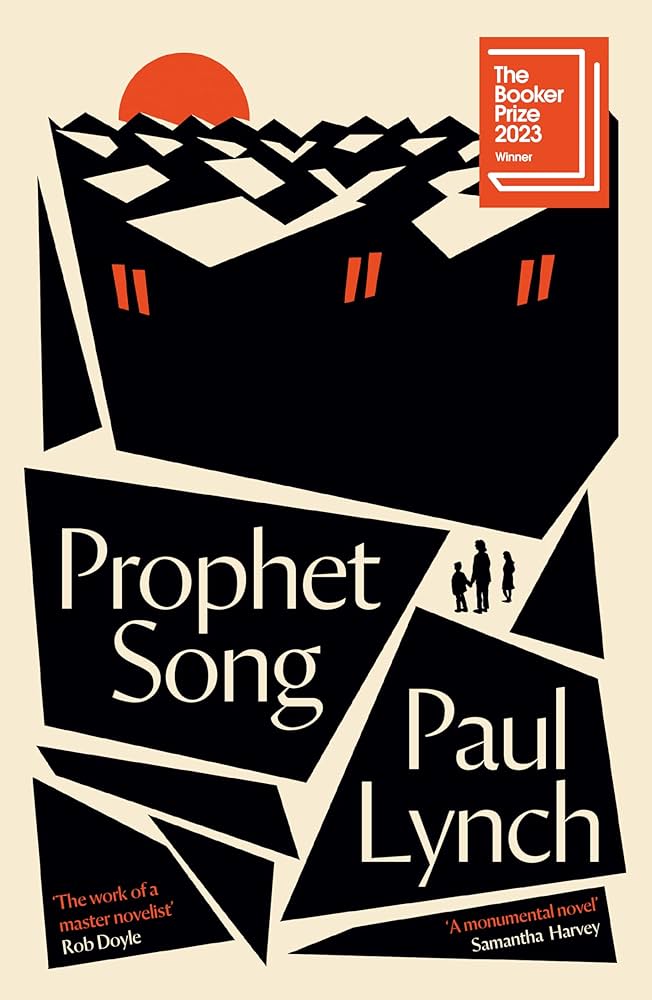
Paul Lynch’s Prophet Song is the sort of novel that gets under your skin: a Booker Prize-winning vision of a near-future Ireland where a family’s ordinary routines deform under the weight of creeping authoritarianism, and every page feels like holding your breath.
Prophet Song by Paul Lynch: Irish dystopian family drama
Published on 7 September 2023, Paul Lynch’s Prophet Song arrives as a stark, thunderous entry into the canon of Irish dystopia. Set in a totalitarian-leaning Ireland, it refracts national anxieties through the prism of one family, making the political searingly personal. It’s the kind of book that wears its year—2023—and its moment like a warning light, and the Booker Prize nod confirms what readers feel in their bones: this is literature sounding an alarm.
At heart, this is a family drama: a mother trying to hold a household together as the rule of law thins to a thread. The state expands its reach, protest becomes peril, and the private sphere—school runs, work emails, bedtime stories—warps under the pressure of surveillance and fear. Lynch keeps the focus tight, so that tanks and checkpoints are never abstract; they are corridors, kitchens, front gardens—spaces where love persists, frays, and must be defended.
Stylistically, Lynch doubles down on immersion: sinuous, unspooling sentences, a refusal to let the reader come up for air, and dialogue that bleeds into thought. It’s rhythm as mood: the breathlessness of panic, the tunnel vision of survival. As a lifelong devotee of sci‑fi and dystopia, I admire how he eschews gadgets and grand designs, choosing instead the brutal plausibility of institutional drift—how the banal becomes the monstrous one administrative inch at a time.
Verdict: 🍵🍵🍵🍵 — Booker Prize-winning nightmare
Four teacups from me: 🍵🍵🍵🍵. Prophet Song marries craft to conviction, its formal boldness channelling a story that feels both intimate and epochal. The emotional honesty—especially around parental fear and the stubborn luminosity of care—kept me riveted long after the last page, kettle forgotten and heart racing.
There are caveats, if only to guide the right reader. The relentlessness is the point, but it can be punishing: hope glints rather than shines, and respite is scarce. If you need levity to leaven your dystopias, this will test you. Yet for readers who appreciate the austere charge of Orwell, the domestic ferocity of Atwood, and the road-dark tenderness of McCarthy, Lynch’s Ireland will feel horribly, compellingly believable.
I often like to share a choice line, but Prophet Song’s power lies in accumulation—the chill settles by degrees—so I’ll spare a pull‑quote and say this instead: the novel teaches that fear is a climate, not an incident, and that resistance can look like making breakfast, telling a story, holding a hand. As a lover of speculative futures and near‑futures alike, I found it a bracing reminder that dystopia is less about distance than direction.
Prophet Song is a bruising, beautifully made warning—near enough to touch, human enough to hurt. Brew something strong, clear an evening, and let Lynch’s vision work on you; it’s not comfort you’ll find here, but clarity, and perhaps the resolve to keep the lights on.