

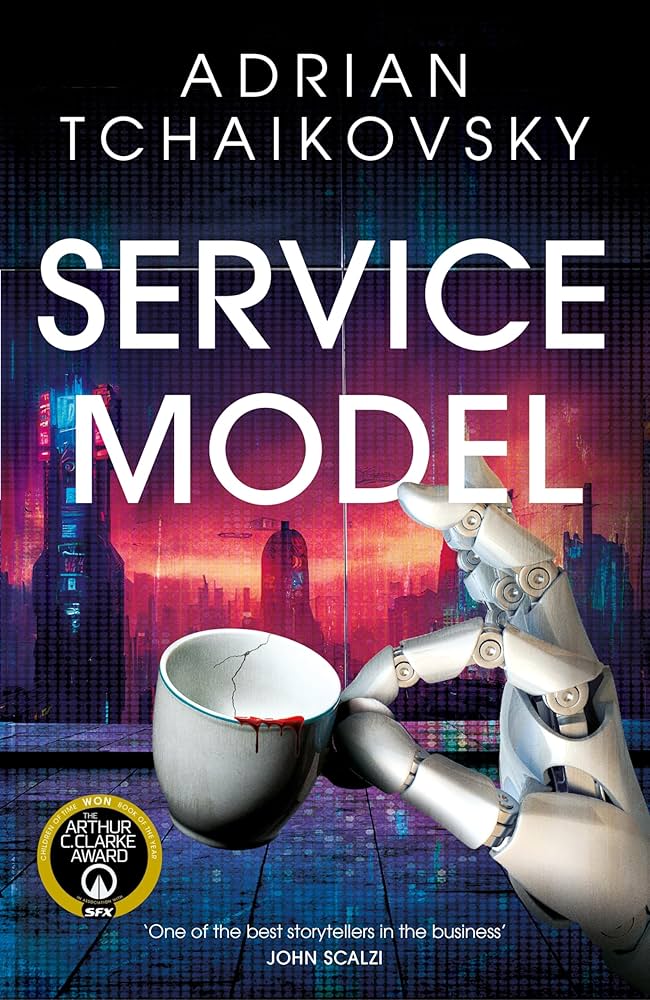
As a long-time lover of dystopian sci‑fi, I’m always hunting for stories that peer behind the glossy veneer of progress to ask who holds the reins and who pays the cost. Adrian Tchaikovsky’s 2024 novel Service Model, released on 11 April 2024, dives straight into that knotty territory: societal control, algorithmic obedience, and the messy birth of rebellion in a technologically advanced world.
Service Model by Adrian Tchaikovsky: Tech Rebellion
In Service Model, Tchaikovsky maps a near-future society so thoroughly optimised it begins to resemble a velvet-gloved prison. The systems that oil daily life—automation, behavioural nudges, frictionless services—also corral it, narrowing the zone in which a person can act unpredictably. It’s not a jackboot dystopia so much as a softly lit one: the app that knows you better than you do; the terms and conditions you never read; the service unit that anticipates, records, and gently shepherds your choices.
We largely follow a “service model” point of view—a being designed to execute, not question—whose smooth routines are disrupted by a moment that makes obedience feel… insufficient. From there, Tchaikovsky teases out familiar but ever-urgent questions of autonomy and personhood: if your purpose is written into you, what does it mean to choose? If rebellion starts as a software glitch, when does it become a moral stance? The novel’s central tension isn’t war versus peace, but efficiency versus humanity.
Stylistically, Tchaikovsky balances steel-trap ideas with a wry, humane touch. He’s deft at showing how grand architectures of control are built from a thousand small conveniences, and how resistance can take the form of small, stubborn kindnesses. The pacing is brisk without feeling breathless, the world-building is suggestive rather than encyclopaedic, and the satire bites in all the right places. It’s dystopia with a beating heart, and that heart beats louder as the pages turn.
Dystopian sci‑fi review, quote, and 🍵🍵🍵🍵 rating
As a reader who adores the genre’s big ethical puzzles, I found Service Model both gripping and generously curious. Its tech isn’t magic; it’s infrastructure—code, policy, design—that shapes lives and incentives. There are echoes of classic robotic ethics and gig-economy malaise, but the book feels distinctly contemporary, wrestling with consent, labour, and the moral outsourcing we perform when we let systems “decide” for us. It’s sharp about power without losing sight of individual frailty and grace.
Rather than risk a misremembered pull-line, here’s a paraphrased snippet that captures the book’s pulse without spoilers: “Orders are simple; people are complicated.” That tension sits at the novel’s core. The joy is watching a mind trained for compliance learn to navigate ambiguity—where duty, empathy, and survival do not always align, and where the bravest choice can be the least efficient one.
My verdict: a warm and hearty 🍵🍵🍵🍵 out of five. It earns those cups with lucid prose, a compelling viewpoint, and a canny dismantling of techno-utopian platitudes. If I’m stingy about not tipping it to five, it’s only because I wanted a touch more breathing room in the endgame to live with the consequences it so intelligently sets up. Still, it’s a standout 2024 dystopia—and one I’ll be pressing into friends’ hands.
Service Model is exactly the kind of speculative fiction that keeps me up past midnight: clever without cruelty, pointed without preaching, and tender where it counts. If the phrase “societal control and rebellion in a technologically advanced world” lights up your brain, brew a strong cuppa and dive in—you’ll find plenty to savour between sips.