
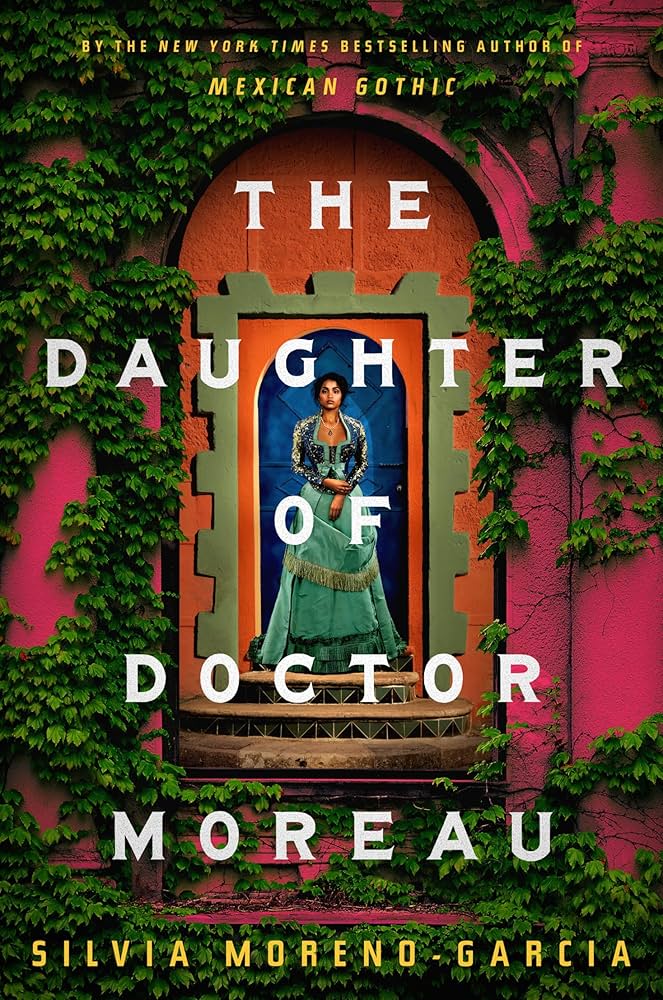
I’m a lover of speculative fiction—particularly sci‑fi and dystopia—and Silvia Moreno‑Garcia’s 2022 novel The Daughter of Doctor Moreau sings right in that register. Published on 19.07.2022, it offers a sun‑drenched, jungle‑dark reimagining of a classic, where a young woman’s sheltered life unravels into revelations about forbidden experiments and the cost of devotion. In short: a woman discovers dark secrets behind a blasphemous science.
The Daughter of Doctor Moreau by Silvia Moreno-Garcia
Silvia Moreno‑Garcia revisits H. G. Wells’s infamous conceit and replants it in 19th‑century Yucatán, infusing the tale with history, heat, and heart. Released on 19.07.2022, the novel unfolds as a lush, gothic meditation on family and faith in progress. Short description: a woman discovers dark secrets behind a blasphemous science.
We follow Carlota Moreau, the daughter of a brilliant, isolated doctor whose “research” depends on debt, secrecy, and the serenity of a remote hacienda. Montgomery, a dissolute overseer nursing his own grief, is brought into their delicate ecology as the outside world—landowners, creditors, and gossip—presses inwards. As pressure mounts, the compounds’ engineered hybrids, loyal and wary, become living proof that the line between miracle and monstrosity is perilously thin.
Moreno‑Garcia’s prose is deliberate and velvety, the pace a confident slow burn that rewards attention. Alternating perspectives lend the narrative both intimacy and moral ambiguity, while the setting—mosquito‑heavy nights, rustling ceiba boughs, chapel candles guttering—does the atmospheric heavy lifting of a great gothic. It’s less about jump scares than the ache of dawning realisations, the way knowledge reshapes love.
A gothic sci-fi of secrets and blasphemous science
What impressed me most is how the novel braids colonial history, class hierarchy, and eugenic hubris without ever slipping into lecture. “Blasphemy” here isn’t merely a theological charge; it maps onto the arrogance of treating living beings as raw material, of bending bodies to ideals. The jungle becomes both refuge and witness, a place where truth refuses to stay buried.
Carlota’s arc feels like a candle being cupped against the wind—her loyalty, curiosity, and dawning anger illuminate the costs of obedience. Montgomery is a bruised echo of the world’s cruelties, forced to choose between complicity and courage, while Doctor Moreau stands as a patron saint of rationalisations. Instead of quoting a late‑chapter line (too spoilery), I’ll offer a thematically perfect echo from Wells: “Are we not men?”—a question that thrums beneath every scene here.
Readers who crave atmosphere, moral tension, and character‑driven stakes will find this intoxicating; those expecting high‑octane action may need to settle into its humid hush. For me, the slow unfurl and the ethical complexity were precisely the point—by the time revelations bloom, they feel tragically inevitable. My rating: 4.5/5 teacups 🍵🍵🍵🍵, with a generous splash for the audacity of its science and the tenderness of its heart.
The Daughter of Doctor Moreau balances romance and ruin with remarkable poise, folding a classic premise into a distinctly Mexican gothic that feels both intimate and sweeping. It lingers where the best speculative fiction does—on the question of what we owe to those we create, and to ourselves. If your shelves tilt towards thoughtful sci‑fi and dusky, vine‑tangled gothics, consider this a strong recommendation.